Voyager 1 Becomes First Spacecraft to Reach One Light-Day From Earth
NASA’s Voyager 1 crossed one light-day from Earth on November 18, about 25.9 billion km away, 49 years after launch. Engineers are also looking into a pause in its data since November 14.
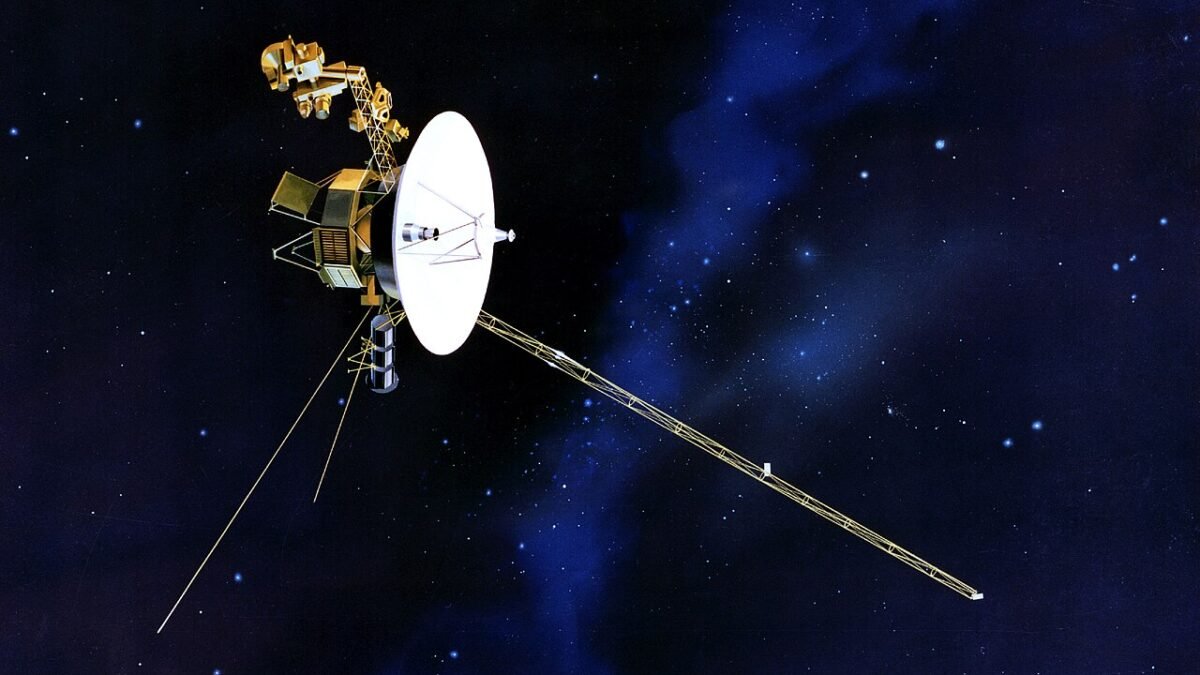
NASA’s Voyager 1 has become the first spacecraft to travel one light-day from Earth, the distance light covers in 24 hours. The probe crossed the mark at 5:16 a.m. US Eastern time on November 18 (3:46 p.m. IST), about 49 years after it was launched in 1977.
One light-day is roughly 25.9 billion km, or 16.1 billion miles. At that range a radio command from Earth takes a full day to reach Voyager 1, and its reply takes another day to come back. The mission team heard from the spacecraft 24 hours after the milestone, once its signal had made the trip home. Engineers confirmed the crossing using the probe’s carrier signal and trajectory calculations.
A data hiccup
The celebration came with a problem to solve. NASA said the team has not received science or engineering data from Voyager 1 since November 14, although the spacecraft is still sending its carrier signal. Engineers are studying the issue.
Nearly half a century in flight
Voyager 1 and its twin, Voyager 2, were launched in 1977 to use a rare alignment of the outer planets. Voyager 1 entered interstellar space in 2012, the first human-made object to do so, and Voyager 2 followed in 2018. Voyager 1 is travelling at about 61,155 km/h.
Both probes run on radioisotope thermoelectric generators that turn heat from decaying plutonium into electricity, and each loses about 4 watts a year. Earlier this year engineers switched off three Voyager 1 devices and replaced them with lower-power alternatives. NASA expects the current instruments, which still measure changes in the Sun’s magnetic field, to keep working until at least the 50th launch anniversaries next summer. NASA’s Deep Space Network listens to Voyager 1 every day and sends commands each week.
Voyager project manager Suzanne Dodd has said the probe may one day fall silent and drift on as a messenger to the stars, still carrying the Golden Record of sounds and images from Earth.
Featured image: Photo: Voyager spacecraft.jpg by NASA/JPL, Public domain, via Wikimedia Commons.
Sources
Related
GTA 6 Makes $3.79 Billion on Day One, Take-Two Says; 32.5 Million Units Sold Before Release
Anthropic Mathematician Says He Proved the Riemann Hypothesis With Claude; Claim Yet to Be Verified