Hera’s First Close-Ups of Dimorphos Show One Face Flattened Into a Huge Crater by NASA’s DART Strike; Hundreds of Boulders Circle the Pair
ESA released Hera’s first close-up images of asteroid Dimorphos on 25 November, four years after NASA’s DART spacecraft hit it in the first planetary-defence test.
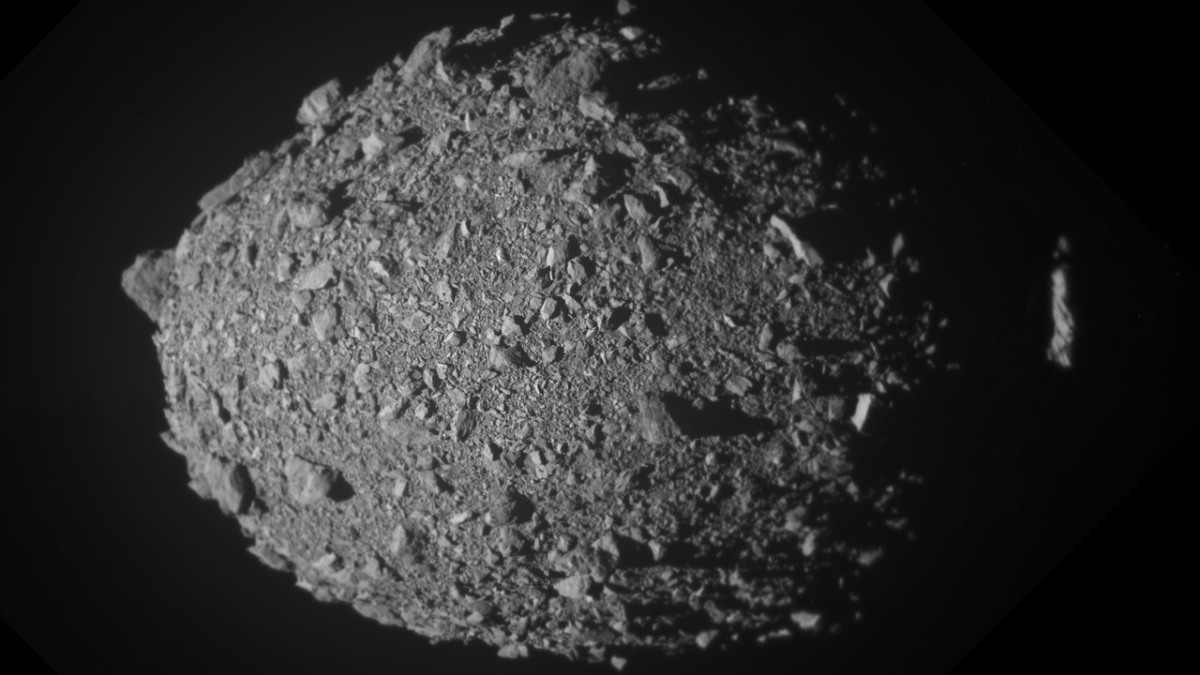
The European Space Agency’s Hera spacecraft has sent back its first close-up pictures of Dimorphos, the small asteroid that NASA deliberately rammed in 2022, and they show that the impact reshaped it far more visibly than many expected. ESA unveiled the images on Wednesday, 25 November, at an event livestreamed from Berlin.
A face turned into a crater
Dimorphos, roughly 150 metres across, now has one side that looks completely changed. Its once-rounded face has been flattened into a crater that seems almost as wide as the face that was struck. Julia de León of the Instituto de Astrofísica de Canarias, instrument scientist for Hera’s HyperScout-H camera, called the crater very big and said it holds unusual structures.
The larger asteroid, Didymos, about 730 metres wide, shows no obvious change: its boulder fields and the ridge around its equator look as they did before.
Hera’s Asteroid Framing Camera captured the system on 3 November from an average distance of about 31.6 km, at roughly 3 metres per pixel. An animation from those frames shows the crater rotating into view as Dimorphos orbits, and the moonlet slipping into Didymos’s shadow.
Boulders on the move
A composite of 11 long-exposure frames taken on 6 November from about 29.9 km, with the two asteroids removed from the picture, reveals hundreds of boulders of different sizes moving around the pair.
Why it matters
NASA’s 576-kg DART probe hit Dimorphos at 6.1 km per second in September 2022 and cut its orbit around Didymos by 33 minutes, from 11.92 hours to 11.37 hours — the first time humans had measurably changed an asteroid’s path. Hera, launched on 7 October 2024 on a SpaceX Falcon 9, is there to study the crater and work out how much the asteroid was changed, so that the “kinetic impactor” method can be relied on if a dangerous asteroid is ever found heading for Earth.
The spacecraft will stay at the system until June 2027, moving closer to aim for detail at the scale of a few centimetres, and will release small CubeSats carrying cameras and radar.
The featured image is NASA’s DART view of Dimorphos taken just before the 2022 impact.
Featured image: Photo: Dimorphos North-Up Image Composition (final 10 full-frame images).png by NASA/Johns Hopkins APL, Public domain, via Wikimedia Commons.
Sources
Related
IBM Quantum Computer Finishes in 15 Minutes a Task Beyond Classical Reach, and Proves Its Answer Can Be Trusted

Vivo X500, X500 Pro and X500 Pro Max Launch in India Today at Noon; Leaks Point to Prices From Rs 1,19,999