‘Black Saturn’: Physicist Finds New Solution to Einstein’s Equations in Five Dimensions
Jay Armas of the University of Amsterdam has described a five-dimensional black hole ringed by a second, doughnut-shaped one, with both spinning in two planes at once.
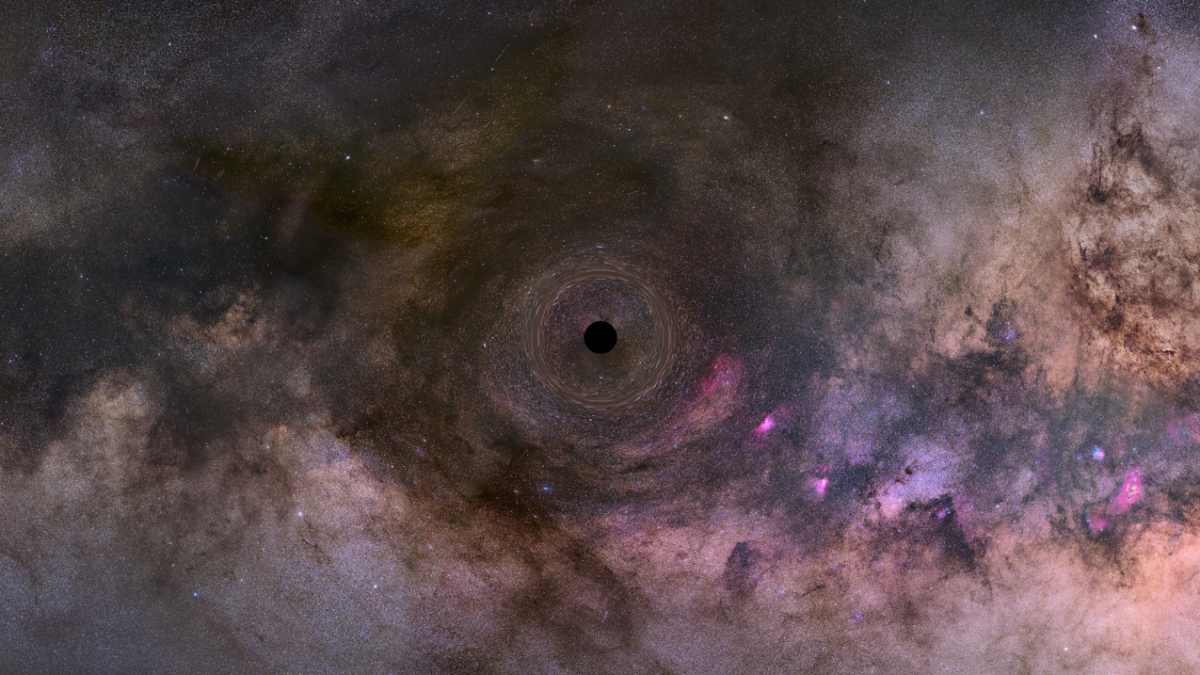

A theoretical physicist has worked out a new exact solution to Einstein’s equations for one of the strangest objects in theoretical gravity: the “black Saturn”, a black hole surrounded by a second, ring-shaped black hole.
The work, by Jay Armas of the University of Amsterdam, has been posted as a preprint on arXiv and was reported by ScienceAlert on 21 November. It has not yet been described as peer reviewed.
A black Saturn exists only in a universe with five dimensions. It pairs a round black hole at the centre with a doughnut-shaped one around it, each with its own event horizon. The outer ring stays in place because it spins; without enough angular momentum, its own gravity would pull it inwards.
When the configuration was first described in 2007, both objects could spin in just one plane. In five dimensions, however, a body can rotate in two independent planes at the same time. Armas’s solution allows both black holes to do exactly that.
According to the report, the new solution shows that the two black holes can reach “extremality” together, meaning their Hawking temperature falls to absolute zero, while each keeps its own horizon. It is described as the first exact solution showing this for two separate black holes in an otherwise empty five-dimensional spacetime. Even so, they cannot settle into full equilibrium, because their rotations would need to match in both planes, which the regular black Saturn setup does not allow.
The study also finds that the ring can drag the central black hole’s horizon into rotation in a plane where that black hole has no spin of its own.
ScienceAlert stresses that there is no evidence black Saturns exist, or that our Universe has the extra spatial dimension they require. Their value lies in testing the limits of general relativity, and the work could help future studies of how light and matter behave around such objects.
Featured image: Photo: Illustration of an Isolated Black Hole (52675793824).png by NASA Hubble, Public domain, via Wikimedia Commons.
Sources
Related

GTA 6 Makes $3.79 Billion on Day One, Take-Two Says; 32.5 Million Units Sold Before Release
Anthropic Mathematician Says He Proved the Riemann Hypothesis With Claude; Claim Yet to Be Verified